My reverse osmosis water filter: One of the most essential parts of my healthy home!
Disclosure: I am an Amazon affiliate and this post contains affiliate links, which means I may earn a commission (at no extra cost to you) if you purchase products mentioned.
Guys, if there is one thing I’ve bought since starting my autoimmune healing journey that I am absolutely in love with, it’s got to be my reverse osmosis water filter!
And I am embarrassed to admit that it took me a bit too long to buy it! Because I was just so nervous to shell out the money, and I wasn’t quite sure which water filter to get. There are just so many out there!
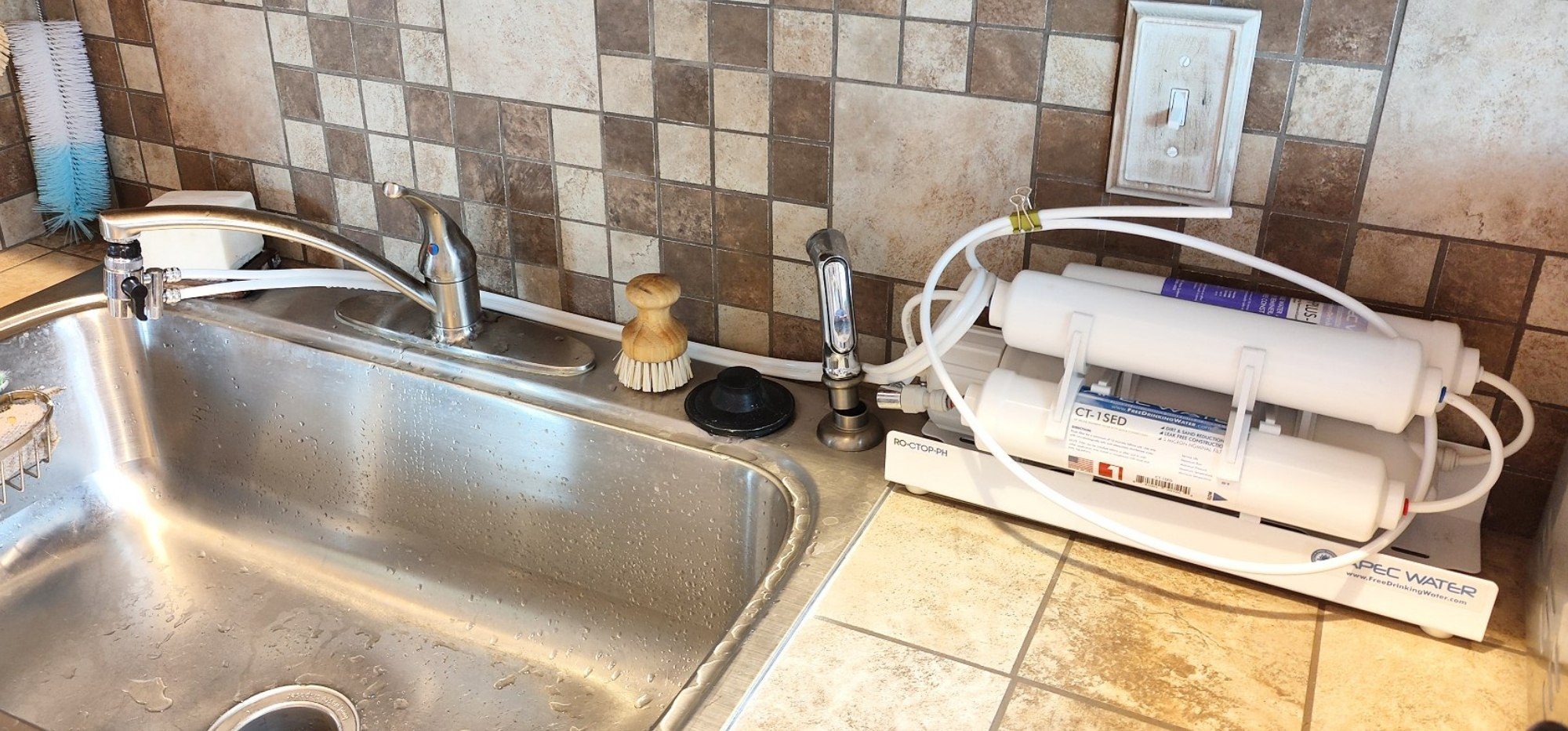
Well, in the end I opted for a countertop reverse osmosis system, since we were in an apartment at the time and couldn’t install a permanent system. I have to say, though, I do love the portability of my little system! I even take it on vacation whenever there is a standard faucet available!
Today I’m going to share with you guys why I chose a reverse osmosis system over the other water filters, why I went with this specific model and brand, and my tips and tricks for using my filter!
Let’s get to it!
Why I ultimately chose a reverse osmosis water filter
When I was first looking for a water filter, I found my choices naturally narrowed down to reverse osmosis systems and the famous Berkey filters.
I knew a lot of people who actually had Berkey filters, so the brand definitely seemed trendy and trusted! However, when I looked into the science behind Berkey filters, I noticed they didn’t subject their filters to the same levels of testing that reverse osmosis brands often do.
And, personally, I really liked the science behind reverse osmosis. It made a lot of sense that when the water molecules are forced through such a tiny little membrane, it forces all other contaminants out. To me, this was a much better guarantor of pure water!
However, I did have one concern come up in my research regarding reverse osmosis water filters, and that was that since they so thoroughly purify your water, they also strip all the minerals out of it. This is obviously a concern! Spring water, for example, is naturally infused with all kinds of trace and healthy minerals. So, it’s definitely ideal to have minerals in your water!
That is why I purchased a system with a filter that adds back some minerals and alkalizes the water. More on this later!
The specific reverse osmosis filter I bought
When purchasing a reverse osmosis water filter, you’ll notice that there are two main types available: ones which go under the kitchen sink, and ones which hook up to your kitchen faucet and sit on your countertop. I do believe there are also ones with a reservoir that you fill manually, but I didn’t look into those.
At the time of our purchase, we were renting an apartment, making plumbing modifications a non-option! So I decided to look for a countertop model instead.
My natural doctor at the time recommended the brand Apec for reverse osmosis water filters. Thankfully, Apec has two countertop models! They’re very similar; both systems have two carbon filters followed by the osmosis membrane. The only difference is that one model has what they call a “pH+ alkaline re-mineralizing calcium filter” following the osmosis membrane. Basically, this adds back some basic minerals which then alkalize the water to some extent.
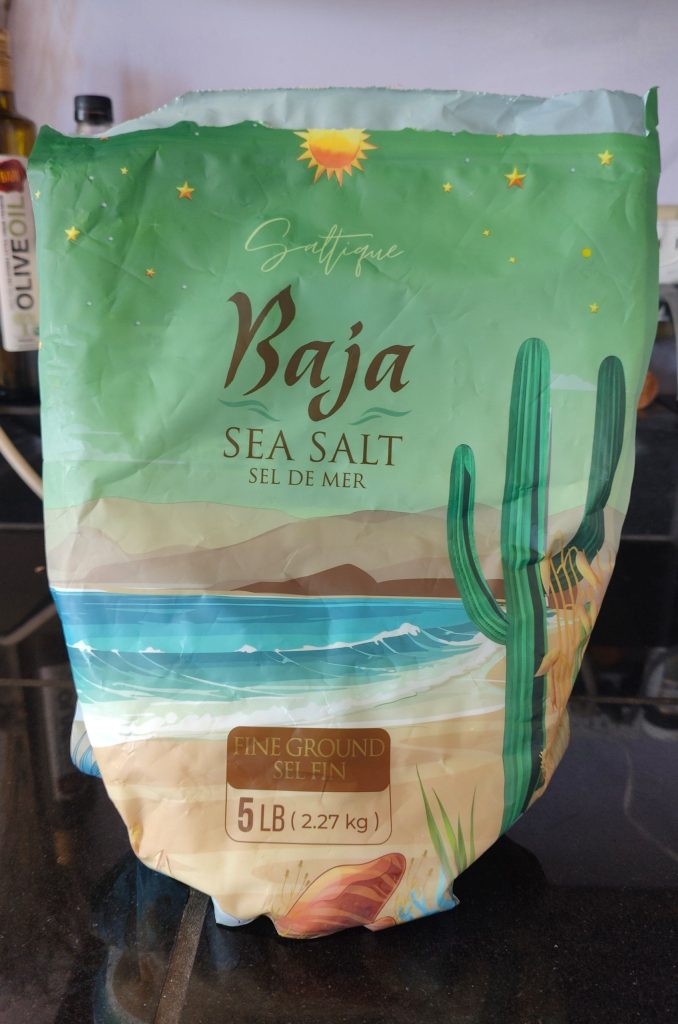
There are other ways to add back trace minerals to your water. In addition to the pH filter, I actually also started adding this fancy sea salt to my water, which contains a ton of trace minerals. I like to make sure all my bases are covered!
Where to buy the reverse osmosis countertop system
Here is the link to the model I ended up buying, which has the pH filter. Apec also sells a version with a nice metal case to make the filter less ugly-looking on your counter, if that matters to you. I would have liked that feature, but didn’t feel like spending the extra money, hah!
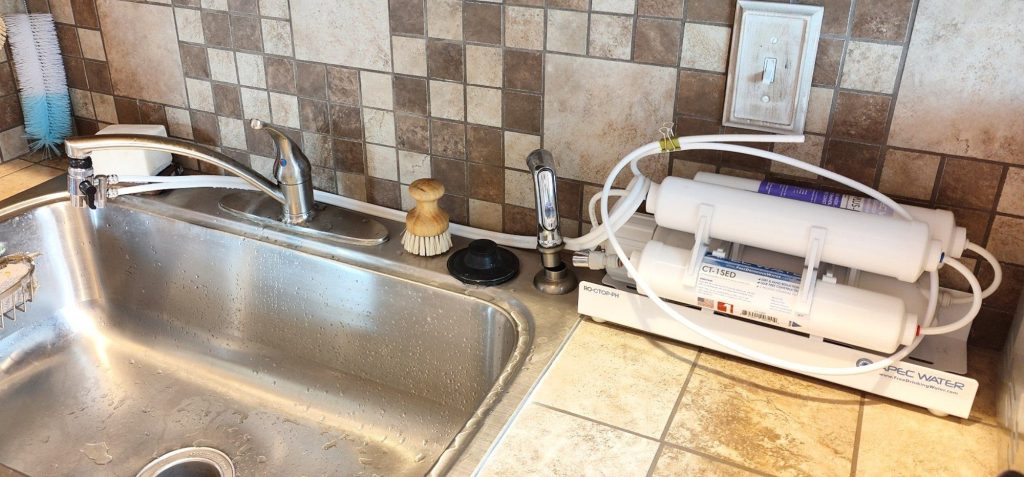
Of course, the under-sink models will do exactly the same thing as this one, they just require some minimal plumbing to be done upon installation. Those can be a great option if you’re not a fan of a bulky filter taking up precious counter space! They even come with a faucet that installs like the sprayer on your sink so you can automatically dispense water. There is a tank that automatically fills with water beneath the sink and is always ready to dispense.
Which brings us to the next point…
Tips & tricks for using a countertop reverse osmosis water filter
The one annoying thing about reverse osmosis water filters is that they are super slow. This is because the water is being pushed through a membrane with extremely tiny holes. Imagine trying to strain water through a super super fine mesh sieve. That’s basically what this filter is doing!
Which is fantastic, since the smaller those holes are, the more stuff that gets filtered out of your water! But again, this means it takes a while.
Certain osmosis membranes have different filtration rates. This specific countertop model comes with a 90 gallon-per-day rating, which means what it says: If you were to leave it going all day, it would filter 90 gallons of water.
I notice it takes maybe 15 minutes per gallon when I filter my own water which, after doing the math on the above rating, is exactly spot-on according to how long they say it should take.
(For those who want the math: 24 hrs/day * 60 minutes = 1440 minutes, divided by 90 gallons = 16 minutes/gallon.)
This means you’re not going to want to stand around and watch your water get filtered, lol!
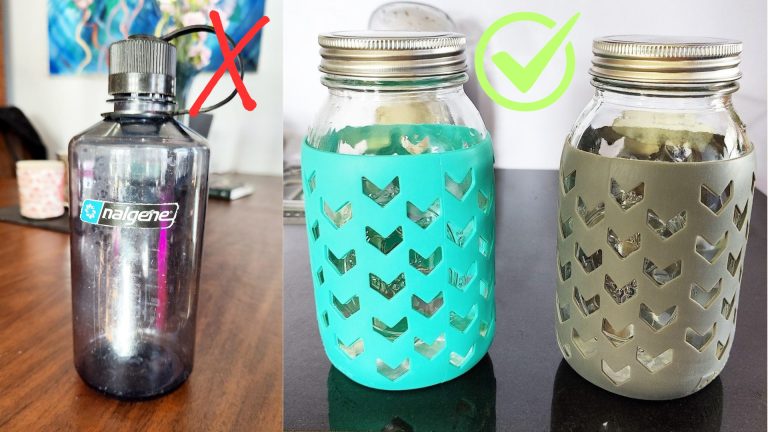
Instead, I have a nice big 2 gallon glass dispenser with a stainless steel spigot (no unnecessary plastic near my water, thank you!) that I fill up every couple of days.
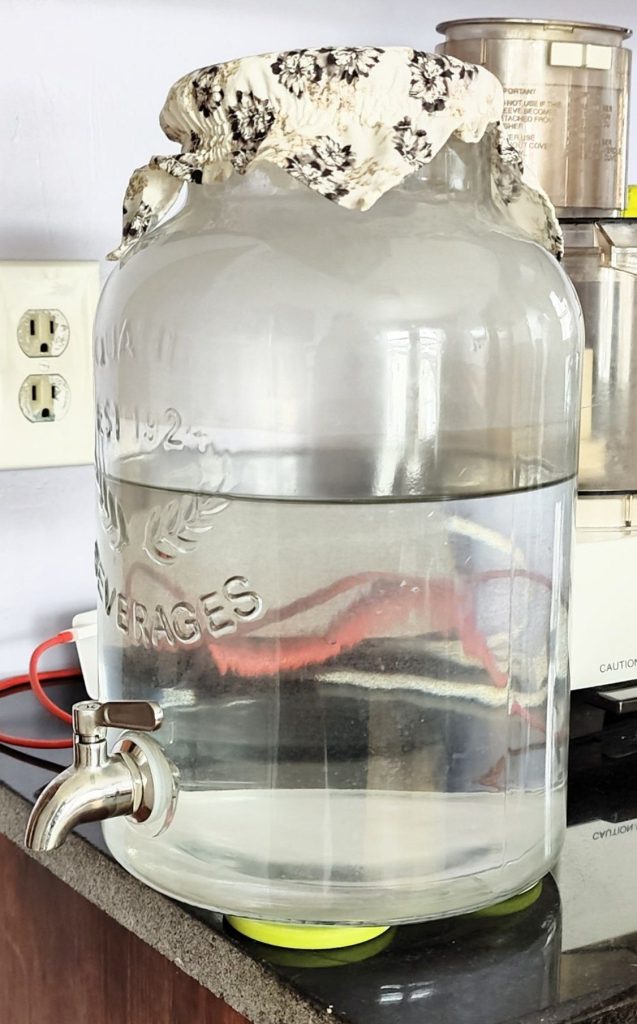
It’s best to cover it with a breathable lid, since airflow helps the water dispense from the spigot. If you like the cute little cloth cover pictured above, here is a tutorial on exactly how I made it!
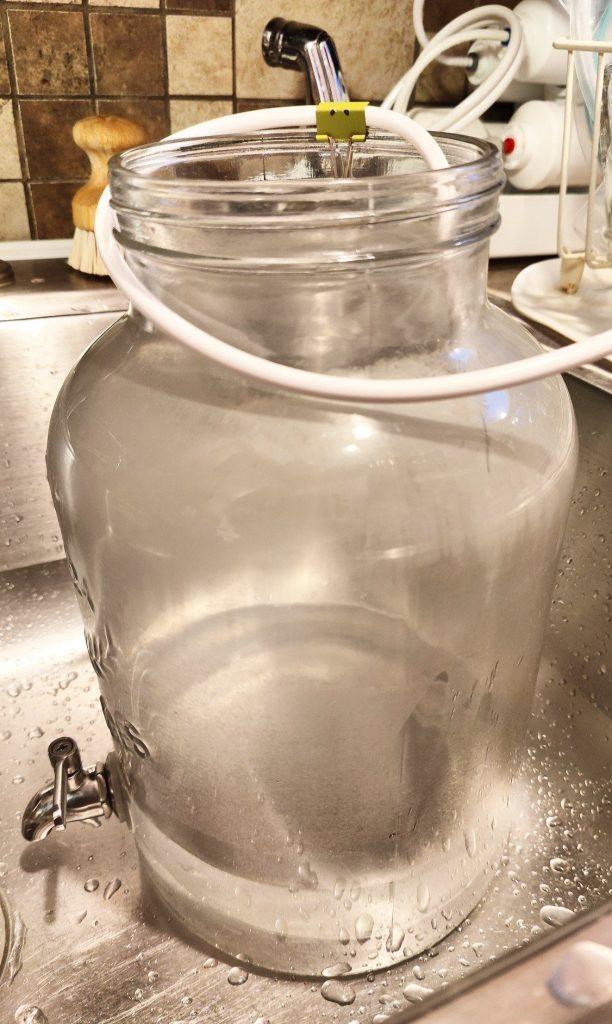
I also use a little binder clip to keep the filter’s output hose in place while it is filling, and cover it with my fabric top again to keep dust from getting in there while it fills.
How I keep a constant supply of filtered water on hand
So now we’re at the important part: Obviously, since this filter processes the water so slowly, I usually leave the room to do other things while my jug is filling. And I cannot tell you how many times we accidentally left ours on too long and got water all over the place, since we simply left the jug on the counter to fill!
We finally got sick of this happening, so here is our foolproof method to avoid this altogether.
When we set our jug to fill, we either:
- Move the dishrack and place the jug on our dishrack’s drainage tray, so any overflowing water drains into the sink, or
- We simply place the jug in the sink while it is filling.
Further, I set an alarm for the approximate amount of time it takes so that I don’t forget about it. Thankfully, with a nice big dispenser, I only need to do this every couple of days.(For our household of 2, anyway… bigger households might need to do it more often!)
What I love about my reverse osmosis water filter!
Since getting my reverse osmosis water filter back in 2022, I have been nothing but pleased with it! Our water tastes amazing and clean. Even our guests notice!
Here are some of the things I love about it:
The reverse osmosis water tastes amazing!
Immediately when we first drank water from our new filter, we were amazed that it tasted so clean. We’d only had a Brita filter before that, and we then realized it really wasn’t doing much! With reverse osmosis, you can really taste the difference.
Very low cost for clean water over time
I also have to say that, for our little household of two, each set of filters lasts us a long time.
Apec says that it’s ideal to replace the reverse osmosis membrane every 2-3 years, and to replace the other three filters every 6-8 months to a year, or depending on how many gallons you filter. Personally, I replace the carbon and pH filters every year and the osmosis every three years. This comes out to approximately $100 a year, or $8 per month.
And when I think about how much people spend on bottled water (which is full of microplastics) or buying reverse osmosis jugs at the store, this is an absolute bargain!
It’s somewhat portable
Compared with the under-sink reverse osmosis systems, I really do like that I can take this one with me without too much trouble.
If I have a place to hook up my filter when I travel, like at my grandma’s house in Long Island, it’s much easier to just bring the filter rather than tons of bottles of filtered water!
Not super expensive
Although this filter was definitely an investment at a little over $200, it’s certainly not the priciest out there! I’ve seen some filters priced around $500! Now that’s a lot for a water filter. And the under-sink models can be even cheaper! So, for this reason, I really feel that reverse osmosis water filters are financially accessible to a lot of people, more than maybe the Berkeys or similar brands.
It doesn’t add too much bulk to my faucet
Before we had our beloved reverse osmosis system, we had one of those annoying Brita filters that connected to our faucet. And it had a little filter cartridge that was super bulky and got in the way of washing dishes and using the sink!
This reverse osmosis system, however, has a very streamlined and unobtrusive faucet hookup.
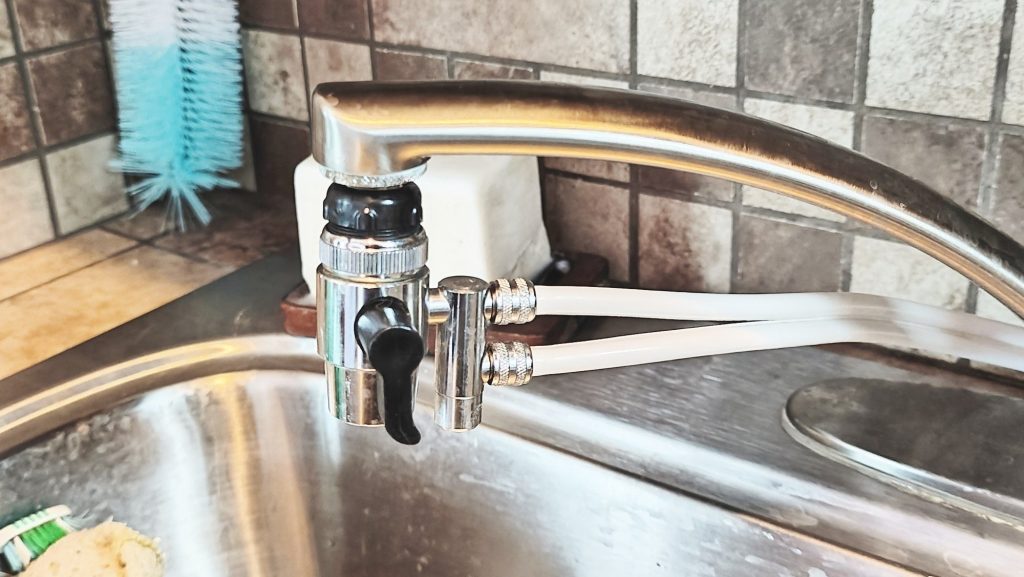
All I have to do is flip the switch upward to filter water and flip it downward to have my faucet back. It’s a great design and I almost forget it’s there!
Some drawbacks to consider concerning the countertop models
Now, let me just point out some potential drawbacks of the reverse osmosis countertop filter. These don’t bother me personally, but they’re good to be aware of before purchasing in case something happens to be a dealbreaker for you!
You need a standard faucet to connect it
One of the major drawbacks of the countertop reverse osmosis system is that it requires a standard faucet for hookup. This is because the connection needs to directly screw on to your faucet. Standard faucets have threading that can be screwed to, but those fancier ones which are becoming more common nowadays don’t have anything like that. So, if you have a fancy faucet, unfortunately this model will not work for you.
If you are unsure whether or not your faucet is a standard or fancy one, check if there is a piece at the very end which screws off, revealing threading. If so, you should be good!
It takes up counter space
As I’ve mentioned throughout this article, a reverse osmosis countertop filter does take up counter space. I sort of just keep mine behind the dish rack beside the sink, so it doesn’t bother me too much. In my old apartment, I even had it mounted to the cupboards above to free up room! See?
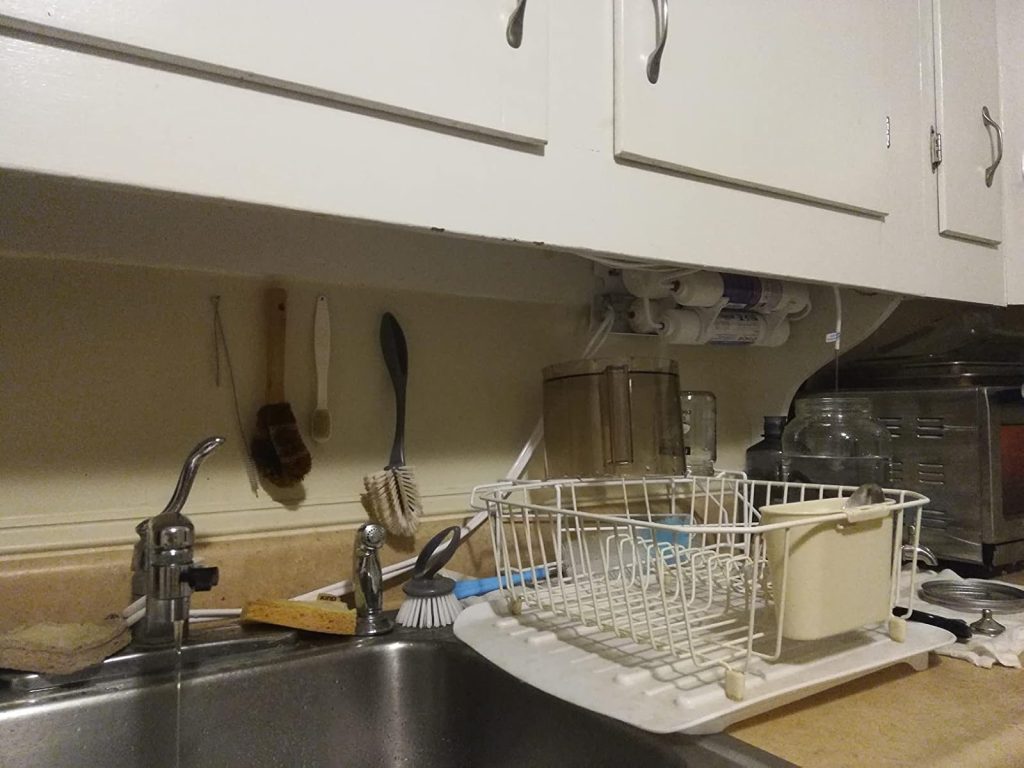
While it is nice to have free counter space, I definitely don’t mind giving some space up in exchange for cleaner water. But if you don’t really want to part with any extra counter space, the under-sink models might be a better bet for you!
Replacing the water filters when it comes time
I wanted to include some information about actually replacing these reverse osmosis water filters when the time comes, just in case any of you needed the resource! I was a bit confused when I first replaced mine.
Timeline for replacement
You’ve probably gathered so far that there are four different filters that make up this osmosis system. They are as follows in this list, which includes Apec’s recommended replacement timeline:
- Two carbon pre-filters (replace every 6 months or 600-800 gallons)
- The osmosis membrane (change every 2-3 years)
- A pH filter to add back some minerals (change every year)
I did the math and figured out we take about a year to go through 800 gallons of water, so I decided to only change out my carbon filters along with the pH filter once a year. I change out the osmosis membrane every three years.
Buying replacement filters
Here are some links for finding replacement filters!
For the carbon and pH filters, you can grab them from this link on Amazon.
As for the osmosis membrane, I figured out that the actual brand which makes these membranes is not Apec, it is in fact DOW Filmtec. So you can buy the membrane directly from that manufacturer. The exact replacement membrane for this specific countertop model is this one, but you can try out different models as well; your flow rate might just be slower depending on the gallons-per-day rating.
A fair warning about replacing the osmosis membrane
One thing I do have to mention, because I recently hit the three-year mark and had to replace my osmosis membrane, is that the cartridge which holds that membrane is insanely difficult to get open!
I’ve seen that sometimes they’ll send you a plastic wrench to give you the proper torque to open it, but my replacement filter didn’t come with one. It’s possible that my initial filter came with this wrench (I can’t remember, honestly) so, if yours does, keep that thing around! You will most certainly need it!
In the end, I was okay because I have tools and stuff around which I was able to use to rig a setup that allowed me to unscrew the part to get it open, but you might not be so well-equipped.
A belt wrench can be extremely useful if you don’t have the plastic wrench they supply you with.
Anyway, just something to keep in mind and mentally prepare yourself for, lol. I had no idea how difficult it would be when I finally went to change my osmosis membrane!
Conclusion
I really hope this post has been helpful to some of you out there who might be on the fence (as I was) about purchasing a high-quality water filter. I really do recommend reverse osmosis water filters so highly!
Though the countertop model works best for us, the under-sink models are fantastic, too, and potentially more convenient and less of an eyesore (as they are hidden in your cabinets). But the countertop model has the benefit of portability!
If you guys have any questions at all, please write them in the comments below and I will be sure to respond! The internet can be such a fantastic resource for all of us to share our experiences and acquired knowledge, making each other’s health journeys much easier, so I’d also love to hear about your water filter and what you like about it!
Thanks so much for being here! Wishing you all vibrant natural health despite today’s crazy world. 🙂 ♥